

Break it down and repeat 7 times
It's possible to make massive leaps in skill, as taught me by an ornery old teacher who told me to drop out of college.

I had two memorable music teachers growing up.
The first was a former Hungarian countess whose concert career was curtailed by World War II and who practiced piano on her knees for 5 years since she couldn’t access a real one. She was intimidating, with a larger than average head (at least in my memory), a propensity to grab your fingers mid-piece if you were doing it wrong, and a husband named Wolf who would regularly contradict her when she was hazing some poor unpracticed student by piping in with: “Well, I thought it was bloody brilliant.” We loved Wolf.
She makes for great memories and helped me recover from a big hand injury, but I didn’t really practice much while studying with her, to be honest. Intimidation only works so well, and I found reading music boring. I improved, but marginally.
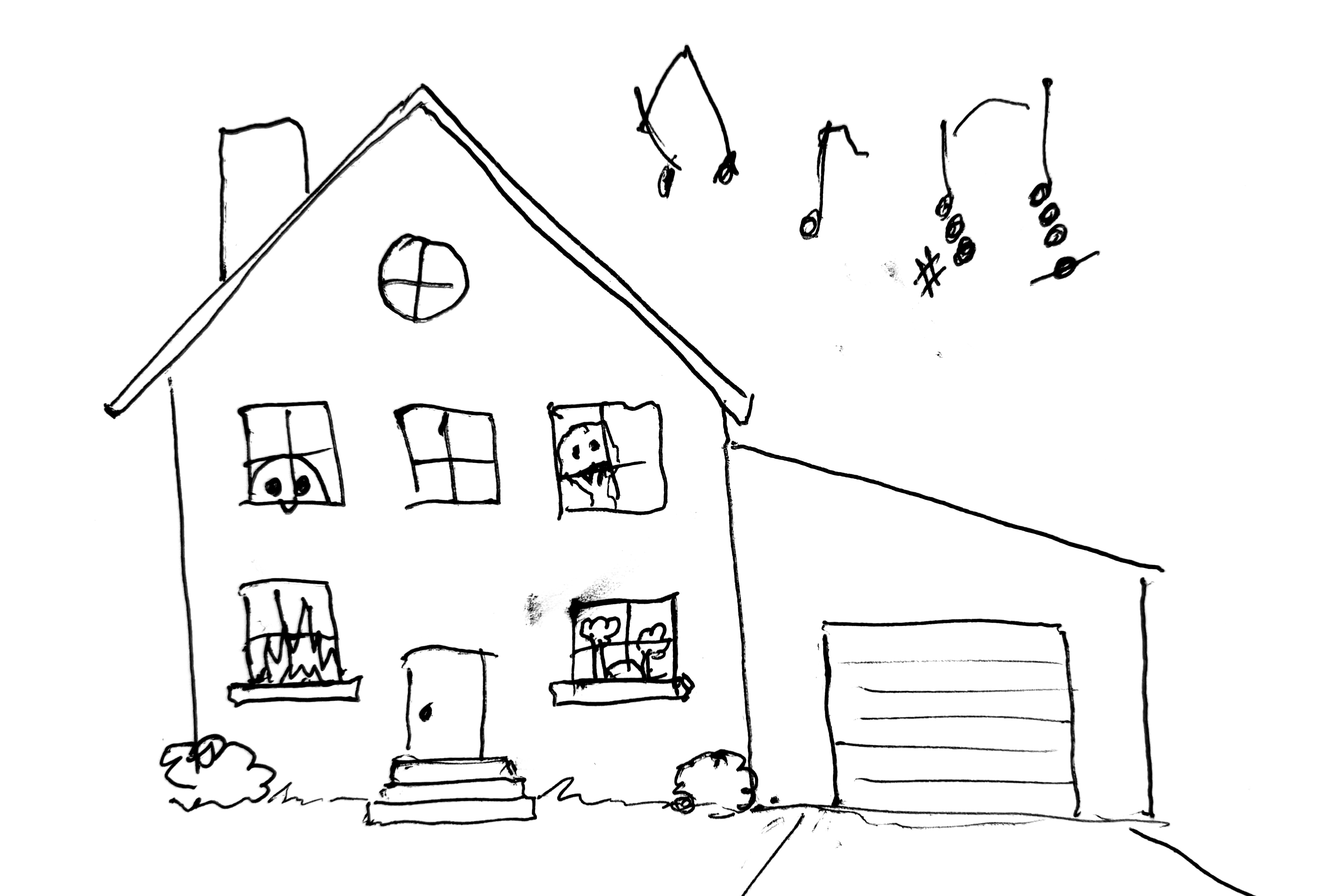
The second was Jay Frederick. Jay lived at the end of a cul-de-sac in the Toll Brothers subdivision I lived in. Cookie cutter house, larger-than-life human.
Jay was a character. If ever there was someone who fit the “ornery old codger” description, it was Jay at the end of a 3 hour lesson when your attention dipped for a second, and you played the wrong chord. Jay once tried to convince me to drop out of college on the idea that the “world doesn’t need more jacks of all trades.” He himself had run away from home at 13 (so the story goes) and made his way to New York City, where he cut his teeth in hotel lobbies and haunted various jazz clubs. He used to tell me how he’d sat underneath Art Tatum’s piano once while he was playing. He ended up a successful jingle writer and friends with people like Oscar Peterson.
Logical to a fault, Jay preferred the intellectual side of music. Anything could be systematized. Everything had a reason to be the way it was. My first ever lesson with him, he asked me to guess how many chords he could teach me in an hour. I was like, “I don’t know, 12?” He taught me the Circle of Fifths and 12 different types of chords in three different voicings each: 12 keys x 12 major/minor/diminished four-note chords x 3 inversions each = 432 chords. I loved it. I started practicing multiple hours a night, piecing these chords together in any way I wanted. The structure gave me freedom, and freedom on the piano is a feeling like no other.
He recognized that I was drawn to improvising and encouraged me in it, but he saw his role as providing scaffolding. Chords, progressions, substitutions, techniques — everything was labeled and categorized appropriately, everything given a use case. A iii vi ii V chord progression was called the Local 807, after the musician’s union. He’d teach me a new song by saying “play 4 half cadences, a rhythm changes, and a 1236 turnaround,” or something like that, and that was meant to be “Honeysuckle Rose.” Homework might consist of things like writing out by hand every possible passing chord between a Dmin7 and a Cmaj7.
The truly amazing thing is that I only ended up studying with Jay for about a year and a half total, my sophomore year in high school and then one summer in college. In that short period of time, I learned the foundation for everything I’ve done musically since then. All my theory knowledge is built on it, my basic understanding of chords, most of my piano technique, and lots of the repertoire I still know by memory today. Maybe most importantly, how I think about practicing and learning.
What a crazy thing. I’ve spent so much of my life playing and making music, and the entire foundation came from basically 200 hours of lessons.
On the one hand, I sometimes look at that and think it’s a missed opportunity. What would have been possible if I’d studied with Jay for longer, or studied music in college, or dropped out like Jay wanted and committed myself fully? What if I’d done 2,000 hours of lessons instead? Or 20,000? I’d be unstoppable, the best to ever do it! People would quail beneath my awe-inspiring piano skills! Lesser mortals would tremble and despair beneath my thunderous playing! (But also, I probably wouldn’t have met my wife or had a gazillion other wonderful adventures, so… tradeoffs).
On the other hand, that’s kind of wild, isn’t it? I mean, I’m not the best pianist in the world by any stretch of the imagination, but I can sit down at the piano and happily improvise for hours on end. Or come up with song arrangements on the fly from a lead sheet. Or play songs by ear. Or write songs, lots of them. Or score a film, jam with friends, orchestrate a string quartet, etc. I know I will happily get to experience the rapturous freedom of running my fingers fluidly across the piano for the rest of my life. I have certainly practiced and studied and learned a lot more since studying with Jay, but it’s all built on that launchpad.
So a couple things I’m taking from this:
First of all, it’s really empowering to realize how much you can learn in a short amount of time with the right approach. Commitment, discipline, the right guidance, the right methods, etc. That approach isn’t always possible on a daily basis — we all have commitments, jobs, family, responsibilities. But it is something you can deploy when you really want it.
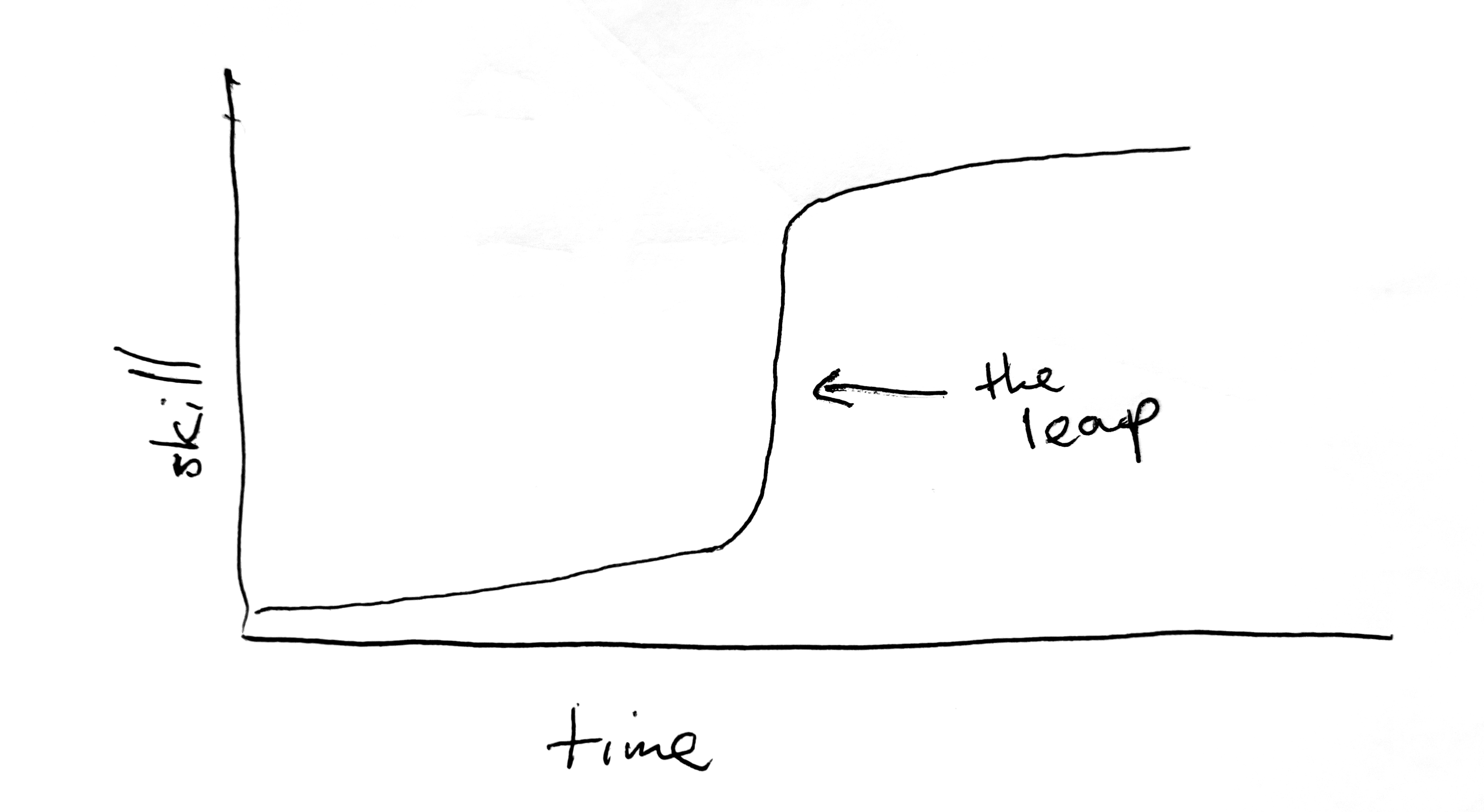
As an analogy, people often study a language for years without being able to hold much of a conversation. But then they spend one or two weeks completely immersed in that language, and they come out conversationally fluent. When you push yourself to learn something, with the right scaffolding, your brain responds.
I had something similar occur with my music last year. I was trying to record a piece I’d written on the piano that I was struggling technically to play. So I committed. I started doing Hanon exercises (for finger technique) every day — for the first time in my life, in fact. I practiced the piece slowly and with a metronome. I went about it systematically, and advanced my technique more in about a month than in the preceding decade.
It’s interesting to note in a lot of these examples, there is a certain amount of slow and steady work that goes on before the leap. When I started learning with Jay, I already had some basic technique from my hand-smoshing Hungarian countess. It’s hard to immerse yourself in Spanish with no Spanish vocab at all to build on. So maybe the process I’m describing looks something like this:
Second, I’m reminded of the value of rigor in learning. Jay considered it a given that you hadn’t really learned something until you could play it 7 times in a row without a mistake. For everything we’d learn, we would break it down into small pieces, practice that piece until I could play it 7 times in a row perfectly, and then move on and combine it with other pieces. This was how I learned songs, chord voicings, arrangements, phrasing, etc.
My latest piano teacher (and course partner with whom I’ve made 6 courses now) Kiefer would agree with this. We’re finishing up his 30 Days of Improvisation course right now, and a theme he keeps emphasizing is that it is vastly more important to have a clear, deep grasp of a small number of things than a wide but flimsy grasp on a lot. This is especially true for improvising vocabulary — the phrases you might use in your solos. Master a few of them, know how to vary them and apply them to lots of different contexts, and then run with them. That’s how you play fluently.
I suspect that’s true for a lot more than just improvising.
I sometimes forget this lesson. I’ll try to learn something new and take the “stumble through it” approach. It’s slow and frustrating. Then, I remember and get to see the contrast. This week, I was learning Chopin’s Prelude Opus 28 Number 15 for my first episode of How to Make Epic Music (coming soon!) and you know how I learned it? One phrase or section at a time, slowly to begin with, 7 times in a row without a mistake. It’s so much faster!
So, this week, consider how you’re approaching your skill development. Are you ready to make a big leap? If so, what systems can you put in place to support it and how will you commit to it?
Jay passed away a number of years ago. My last conversation with him, he was still angry with me for not committing enough to music, but I’m fine with my decisions. And yet, I’m so grateful for what he taught me — most importantly, the ability to learn things, a skill I can deploy anytime I want. That’s certainly worth a grumble or two.
Musically yours,
Ian
Ian Temple
Founder, Soundfly
ian@soundfly.com
Do you like my writing? If so, support my work!
I’ve (finally) launched a premium tier for my Substack. It will be focused on my new series How to Make Epic Music, which will have in-depth articles and audio, with original music in it. I’m running a little “launch discount” now, so get 20% off here:
Five Interesting Things
Apparently, The Bad Plus is calling it quits. If you haven’t spent time with them and their jazz-y, fusion-y, slightly punk-ish piano trio music, I highly recommend it — their covers (especially Aphex Twin’s “Flim”) are the stuff of legends. I’ve been enjoying reading the former pianist ETHAN IVERSON’s in-depth explanations of how they came up with those covers.
“this turn-of-the-century “knowledgeable white boy, rebellious with a tender side” thing we offered was unquestionably fresh… When I walked out of The Royal Tenenbaums it was totally obvious to me that Bad Plus was supposed to be the jazz version of whatever that was” — Ethan Iverson
“Oh boy! This is my lucky day!” I love this short excerpt of Kurt Vonnegut talking about the mathematical shapes of stories. I suspect you could do something similar to this with song structures.
1 Million Monthly Listeners. 12 Tickets Sold. This article by Joel Gouveia so accurately describes the current strange music listening environment we live in. When we were making courses with artists on Soundfly, we’d work with an artist with 2 million followers and no one would sign up. Then, we’d work with an artist that had 50,000 die hards and it would sell out. As an artist, I suppose the takeaway is to think very clearly about what metrics you really care about in terms of followers, which ones will actually lead to the success you want.
This week, I got to hang out with pop artist Betty Who. If you don’t know her, her music is anthemic and incredibly joyful. Before meeting up, I spent some time with her back catalogue and ended up crying my eyes out over this viral video from 2012 of someone proposing to their husband to a flash mob dancing to one of her songs. Remember when this was what the internet was like? Bring back this energy!
I got so many amazing, thought-provoking, and challenging answers to my writing on AI last week, ranging from “f&*^ you, I hate you” to “I’m concerned about the environmental and societal impacts” to “it helps me be creative” and much more. It’s clear a lot of us are still wrestling with this and what it is and how to use it. If you’re interested, dive into some of the comments.
Loved reading your story.
Reminds me of my journey a little bit. I had one teacher that made everything click theory wise, loved her, only saw her for two years and then my husband was transferred for work. But everything she taught me I still go back to today.
Your improvisation course coming out sounds very good.
Also: I so love the drawing for this piece. :D