

Drinking from a firehose
How do you make sure you're constantly bringing in new creative fuel?

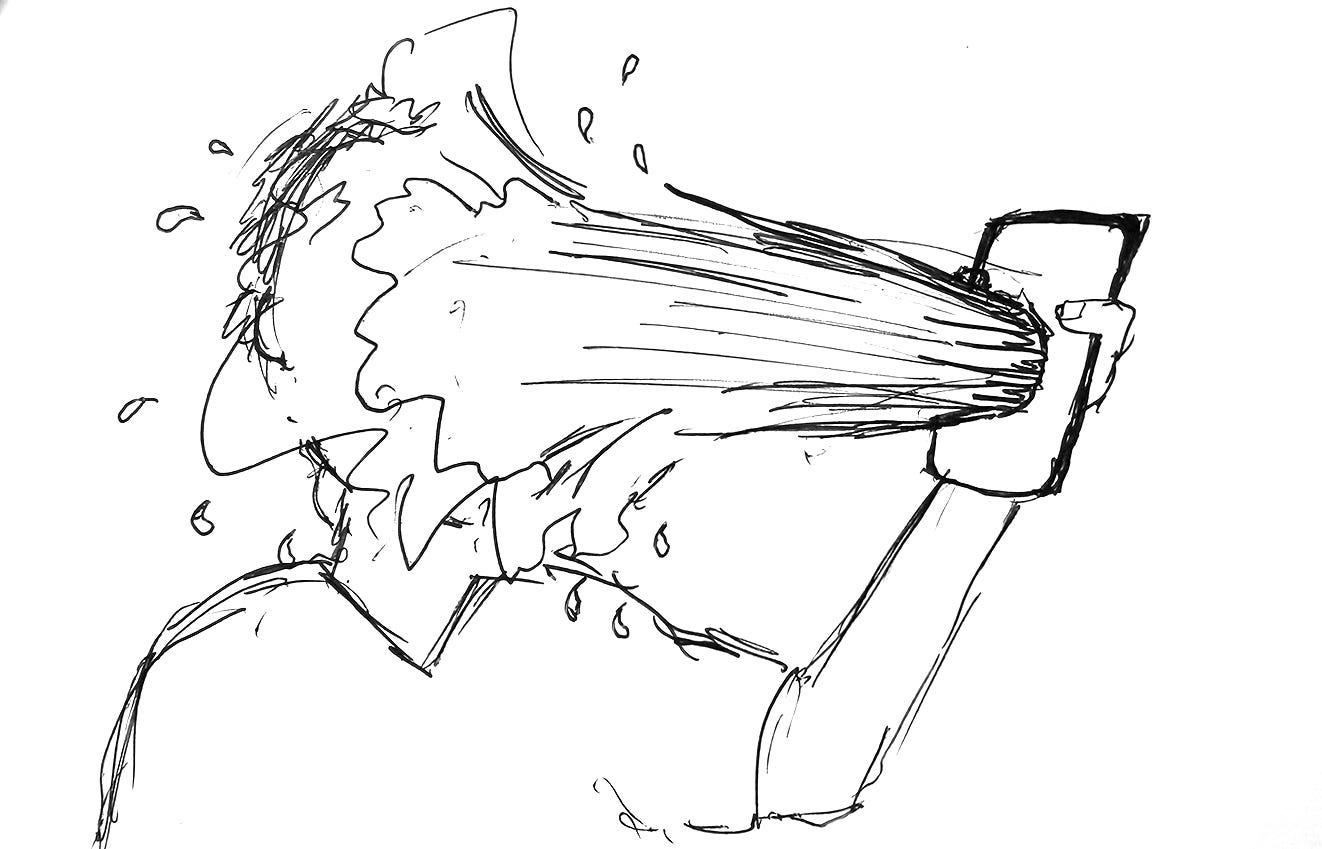
“Creativity begets creativity. When we engage with creative work, we set a higher standard for our own work.” — author Roxane Gay
Is it possible to be an artist without having a deep relationship with other art and music?
If we’re being truthful, the answer is probably Yes. Every once in a blue moon, I meet an artist who seems to have been birthed in a vacuum, without obvious heroes or years of study. They exist. They’re strange and singular, a product of some cosmic trick played on us by the gods.
But what’s much more common is that I meet an artist doing incredibly interesting things, with a passionate fanbase, and I discover that they have a deeper relationship with other artists, influences, and music than I could ever imagine.
They can list every piece of gear Prince used in Sign o’ the Times off the top of their head. They know every Bud Powell solo by heart. They reach out to bespoke synth manufacturers in Italy to get the same synth used by their favorite band. They spout snippets of obscure philosophy, reference dissident artists from imaginary countries, or rank one-handed piano concertos to taste.
They KNOW stuff. They’ve studied it, often on their own and with great obsession.
I recently hosted a course with the pop artist Betty Who on lyric writing, and in the conversations we’d have, she would whittle off lyrics from any number of artists she loves with total ease. Every concept we discussed, she’d call to mind three examples. The funny part is that I don’t think she even noticed or considered that it might be exceptional to have memorized literally hundreds (maybe thousands) of songs. She just did it as a matter of course.
It’s one of the most profound differences between the true professionals and the rest of us who aspire to be: Have you spent the time to be a student of the greats, to dig into the stuff that inspires you with depth and vigor?
The pianist Kiefer talks about how often he gets a new student who comes to him and asks the relatively banal question “how do I play like Herbie?” or “how do I sound like Robert Glasper?” To which he always replies: “How many Herbie songs have you learned? How many Glasper pieces do you know how to play?” And almost invariably, they look at him blankly. None. They didn’t think to do that.
Sometimes the easiest routes are the hardest to see.
So yeah, I don’t think it’s incredibly controversial to say that in order to be great at something you need to immerse yourself in it — to fall down its labyrinthine passageways in whatever way you can, to wrap the many dimensions of its messy existence around your shoulders like a misty cloak, to get lost in the petty dramas and exhilarating grandeurs of its unique development. You need to learn shit.
But here’s the thing: When I recently brought this up to some musicians in my accountability group, the response was mostly: “Yeah, we know, but our problem isn’t spending time listening to music — it’s that we’re taking in too much.”
It’s true. The content is a deluge. Every time I lift my phone, it’s like raising a firehose to my face and trying desperately to get a sip while waves of high-pressure water unceasingly blast my receptacles.
We’re taking in a lot. It’s just that very little of it is actually sticking with us. It’s not uncommon for people to listen to 8 hours straight of music in today’s day and age without being able to name a single artist they listened to (someone literally told me they did this yesterday).
And even those of us who are more careful with our intake, it’s still a f&*^ton. The problem isn’t that we’re not listening to enough music or digesting enough art, usually. The challenge is that we may be doing it without actually taking anything in.
So how do you deal with that? We artists need creative fodder — but we don’t have much time, we’re swamped with shit, and it’s tough to manage it all. How do you ensure that you’re constantly feeding your artistic vocabulary in a productive way without getting overwhelmed by it all?
What’s Your Input Persona?
I came up with a concept for my Draft // Echo group last year that’s helped me, and maybe it’ll help you: The Input Persona. Basically, the idea is that you come up iwth a character based on your strengths that guides you in how you learn.
Let me give you an example. Questlove of the Roots is one of the voracious musical archivists of our time. It’s clear in everything he does — whether playing covers at a dime on Jimmy Fallon, producing films and documentaries on important events in music history, or DJing sets filled with obscure funk and soul music. In the Fall, I went to a DJ night he was hosting where he only played obscure live Prince songs — for like 6 hours straight. He knows recorded soul music inside and out.
I’d say his character is an Archivist. The Archivist, in fact. He could be hired by the government to preserve our cultural legacy.
I could never be like Questlove. I don’t know why, but it’s not the way I work. I’ve tried at times to gain a wider breadth of artistic knowledge, but for me, none of it sticks. I can’t remember specific record names or song titles. Maybe with flash cards I could get better, but I’ve got no natural file system the way he does.
That’s because I’m an Educator. That’s my input style. What I love to do and what I’m good at is going absurdly deep on something specific in service of sharing it with someone else.
For example, I recently decided to write an article on Chopin’s Raindrops Prelude. I learned the piece and started to analyze it, but before I knew it, I’d read 3 biographies of Chopin, watched about 12 YouTube videos, listened to multiple podcast episodes, and created a 30 minute podcast episode about it. It felt completely natural and enthralling to me.
Since I realized that’s how I work, I’ve started to lean into that. It’s a big reason I write these newsletters. And when I want to study a topic, I know that the best way to incentivize myself to do it and to ensure I truly digest it is through sharing it with someone else in some way.
There are many types of personas you could take on. Synthwave artist (and Soundfly instructor) Com Truise is a Hacker. He likes to try to go behind the scenes and understand the code behind everything he uses. He loves going down an internet rabbit hole on specific sounds trying to unearth everything about them and how they were made.
Film scorer Cristobal Tapia De Veer sounds like an Anthropologist (based on interviews I’ve read). He talks about how he’ll immerse himself in a particular musical tradition or subculture sometimes for weeks at a time to understand as much as he can about it.
My friend Ewa Łączkowska sees herself as a Hunter-Gatherer, which means that she’s someone always on the move, following little traces here and there, enjoying anything that’s edible. As a hunter-gatherer, she can’t afford to be picky, and while she often returns to places that have borne fruit in the past, she can’t be fixated. Always to the next one.
She’s even taken the concept one step further by asking herself: What does a hunter-gatherer do? And then using the answers to that question as creative inspiration throughout her process. For example, “if your environment doesn’t feed you, move on” and “make your own tools.” I can definitely see how those characteristics could be really fun problem-solving tools, constraints, or things to play with when making music.
I’m not sure this concept is groundbreaking — but it has stuck with me. Learning that educating others is one of the most effective ways for me to expand my own learning has guided me a lot over the past couple years. It’s become part of my daily and weekly practice in a variety of ways, from writing these newsletters to making random presentations for my family to showing something to a friend.
So... What’s your input persona? Based on what you know about yourself, what’s a good way that you can break through the constant noise and input new material in a way that will inspire and inform your art? Give it a name. Take on the role. And maybe it’ll help.
Happy listening,
Ian
Ian Temple
Founder, Soundfly
ian@soundfly.com
In Other News…
Kiefer’s 30 Days of Improvisation starts next week.
Kiefer’s intensive course 30 Days of Improvisation starts NEXT WEEK. If you’re a pianist wanting to focus on soloing and improvisation for a month, this is definitely for you. You will learn A LOT. You get a lesson a day for 30 days, 5 group Zoom calls, and a lot of practice activities and exercises. Sign up here with the code “summersale” for 30% off the price.
I’m running my first marathon. Help pressure me to finish.
Not music-related, but I’m running a marathon in memory of my cousin’s son Max Robinson who passed away from leukemia only 5 years old. I’m raising money for Blood Cancer United to help fund treatments into leukemia and care for patients. If you’d like to heap pressure on me, I’d certainly appreciate a donation on my fundraising page here.
New music from friends and acquaintances.
Alexandros Miaris from the band Electric Litany has re-released a solo work of his that I truly love. It’s called Selected Works for Film and Modular Orchestra, and is peaceful, full, and delicious.
The band Memorial has a new soft, intimate album on the OPIA label I love so much (and whose Discord I moderate). It’s melancholy and soft, but really gorgeous and will make you smile.
Another OPIA member (and past member of my Draft // Echo group) Tó Anjo has a short but stunning electronic EP called Worldbuilding, Vol. II that I can’t stop listening to, especially the song “Heavendrop.”
My friend Kiefer has a groovy new album with Nate Smith, CARRTOONS, and Kenny Beats full of soulful beats and jazzy riffs called FATHERS. Kiefer also has a solo album coming out in September called Memory Bomb, and just dropped the first single here.
Drinking from a firehose is such a great way to put it. This is the curse of our times of "everything everywhere all at once, at the reach of your hands". I think that artists in the past had less access to things and that is what made them go deeper. This feels like the thread connecting all the input personas you described - they go deep. They immerse themselves. If I'm on a hunt, tracking, and get distracted by other potential prey, I won't eat in the end.
The recipe stays the same: slow down and take time with things. Do one thing at a time. Pay attention. What you said in the group - disappoint some people by not being available for everything, carving out time instead for that one thing that has your heart you at the moment. And really taking this time. It's like with making friends - even if the friends you're making are people you've never met except in their music/art.
I have to think now about the advice you often give: if you can't seem to reach your weekly creative goals, make them smaller. But smaller can also mean "deeper". Allowing oneself to sit with things without getting distracted, and immerse yourself - both in inputs and outputs.
(Or maybe I'm trying to excuse the fact that I have two lines of a song to show for this week, a song that wasn't even on my list of goals for this week, but was a reaction to what is happening right now in my life.)