

Earn it
As artists, we're asking people for the most valuable gift they can offer.

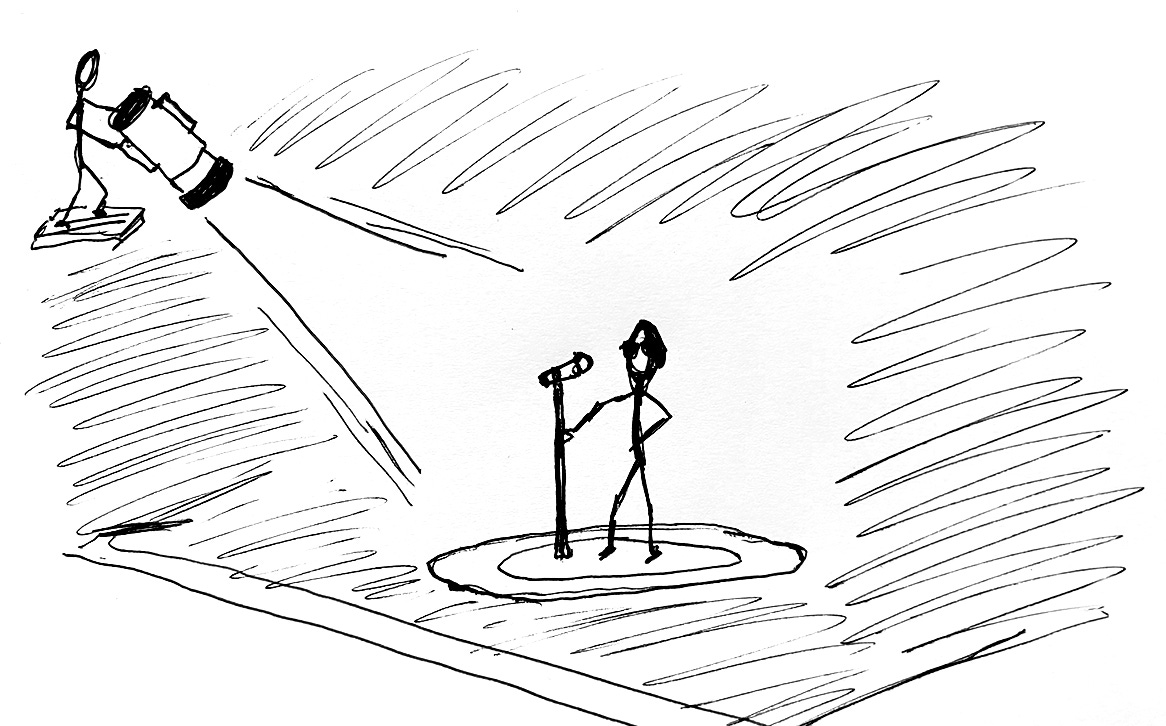
What’s the best gift you can give someone?
If you answered the new 8,000+ piece Minas Tirith Lego set just announced, then we’re going to get along just fine. That’s objectively the right answer.
But sadly that’s not what I’m talking about today. I’m talking about something a little lamer, but hopefully more meaningful.
The answer is your attention. Your undistracted, unmediated, undiminished attention, the sort of attention that crosses chasms and connects you at your core. Attention is both a form of love and allows love to grow. It’s your very own spotlight, one that you can turn on anyone at any time to give them a stage and make them shine. It pierces darkness and uncertainty to open up space and clarity.
Have you ever had one of those conversations with someone where one of you is not fully listening or paying attention? It’s so weird and off-putting, far beyond what it seems like it should be, like some social systems somewhere are malfunctioning. Like we’re not actually the same species anymore. I thought I knew how to talk to people, but am I doing this wrong? Are you? What’s happening here?
I feel like we should normalize hard resets in those moments. I could imagine a simultaneous face slap working, though a bit violent. Maybe two spins, a chest bump, and a loud “HAH” would do the trick. I don’t know, just riffing here.
The problem is that we don’t actually have that much attention to give — even before considering all the juiced up, brain-hacking content algorithms grasping at our eyes in competitive desperation.
Giving attention can be hard! It takes an alert mind. And humility. And confidence, quieting your inner voices and anxieties. And the ability to focus, even when the caffeine is wearing off. And time of course. And a whole bunch of other stuff, each one of them operating according to its own scarcity rules. Sometimes you’re tired. Sometimes there’s really important stuff happening off-screen. Sometimes you’re bored. Sometimes an app has hijacked your dopamine centers for profit. Sometimes… you’re a walking bag of sentient meat whose instincts and actions are firing in ways you don’t expect and can’t fully control.
As artists, authors, and musicians, this is what we’re asking for every day. We’re asking for people’s attention.
It’s a lot. Think of what we’re competing with. For one thing, there are the millions of other artists, authors, and musicians out there also asking for people’s attention at the same time. Every time someone listens to one of my songs, they could actually be listening to Radiohead or Chopin or Green Day instead. How am I meant to compete with Whitney f&*$ing Houston? Her voice is a soundstorm, a rolling tornado of beauty that hoovers up all in its path, that rips the roofs off houses and changes people forever. If you listen to Sontag Shogun instead of Whitney Houston, I have questions about your sanity. And yet, shockingly, people make that questionable choice every single day.
But there’s more. It’s not just the competition with other artists. When you ask for someone’s attention, you may be taking it away from their friends and family, from sharing a quiet, affirming moment with their partner or seeing their child experience moments and milestones they’ll never experience again.
Or you could be taking them from projects they’re working on that could alter history. The time they spend with you could be time spent discovering a new subatomic particle that allows accessible space travel or something. I’m not a scientist but it seems like a possibility. Or sitting in stillness, which is more than capable of matching and surpassing any possible meaning you can offer.
When you stop and think for a second, there’s something awe-inspiring about this, that we get to experience a life so endlessly competitive for and worthy of our attention.
But for us artists, it’s also a responsibility. It gets at one of the core tensions of being an artist: We make art because we feel called to do it from somewhere within ourselves, because it offers us a form of meaning and excitement and beauty to do so. And yet, we also do it in service of other people, to offer them the same sort of meaning and excitement and beauty we might find in it. And for that, we need to earn it.
This week, my friend (and pop artist) Betty Who made a point in class that challenged and resonated with me. She was writing a new song on camera, always a difficult thing to do. She’d come up with a chorus she liked but that also felt a little overly sentimental. So when she began working on the verse, she decided she needed to earn it more. She needed a verse that would earn people’s attention so that the chorus felt meaningful and (unstated but implied) didn’t waste their time.
What a beautiful sentiment. What a wonderful reminder that we’re not ever entitled to someone’s attention. After all, it’s one of the most precious things we all have to give. If we want to be worthy of it, we need to earn it in some way, to make the efforts, insights, and entertainments that will reward it with joy, realization, and meaning.
How do you actually do that? Practically speaking, there are as many possible answers as there are fish in the sea. You can become a virtuoso and do something no one else can do. You can crash through barriers people didn’t even know were there, add the accordion to your thrash metal band or transform the human voice into something unexpected. You can surprise people or reach them with the exact thing they needed to hear in the moment they needed to hear it (my goal frequently with this newsletter). You can hide easter eggs in your work or offer the level of exquisite detail that transports them to another world, away from the pains and practicalities of this one.
One person who took this responsibility very seriously was Berry Gordy, the founder of Motown. He knew his artists faced even greater obstacles for attention than white artists at the time, that they needed to earn it even more. Because of that, they would have meetings where they ran songs and records through what he calls the hot dog test — that is, if someone were down to their last dollar, would they spend it on this record or on a hot dog? If for anyone in the group the answer was the hot dog, that record wouldn’t get released, or would go back into production.
Gordy was specifically making hits, and I’m not advocating that every song needs to grab your attention in the first 15 seconds like he did. Lord knows there’s enough garbage on Instagram trying that. For me, it’s more about the mindset — about not taking people’s attention for granted, about trusting your instincts for what will move someone, and then pursuing that.
But really, for me, it comes down to care. It’s putting the sort of care and consideration into your work that makes it clear you understand the stakes of what you’re asking. That you understand that every time someone turns their spotlight your direction, they’re giving you a gift and the most loving and respectful thing you can do in response is to make it deeply worth their while.
If you do that, you’re not only honoring their gift. You’re giving it back to them. And that’s a beautiful thing.
Have a great weekend,
Ian
—
Ian Temple
Founder, Soundfly
ian@soundfly.com
Interesting Things
RIP Sonny Rollins. I can still remember being 16 years old and listening to him with Thelonious Monk for the first time while traveling on my own. It was the sort of music you could dive into all the way and take years to find your way out of. It was as big as the entire world somehow. I loved it. Austin Kleon shared this really cool little animation of a Sonny Rollins interview that’s worth a watch.
My friend Zac Hill referenced me in this little piece he wrote about how AI for learning needs to look drastically different than AI for other things. I agree. Learning requires effort, exploration, and inefficiency. AI too often short circuits that stuff. But I also feel an AI with different constraints and parameters maybe could support that stuff in pinpointed ways. It’s just something I’m curious about.
My friend the amazing Tyler Gilmore (aka BlankFor.ms) has a new album out called Shards with Jason Moran and Marcus Gilmore — and was featured on the cover of Downbeat magazine this month! What a cool thing. Listen to the new album here — experimental jazz at its best.
My little brother won an Emmy!!! He makes documentary films through his company Optimist, and he was a producer on an amazing documentary called Champions of the Golden Valley about skiers in Afghanistan. You can stream the whole thing for free here on the Olympics website. Yay!
Hmm, a few aspects coming up for me... Not really coherent yet, so forgive the side-tracks.
First, I really expected you to end this with "things made with attention earn the attention of others" :P Which you kinda did!
But it's a more complex dynamics, I think - especially in our times of so much slop and everything trying to steal your attention, when the mainstream entertainment is basically treating the audiences like idiots. You see it especially within film, where scripts are written assuming the viewer scrolls social media on their phone while watching, so everything needs to be explained, multiple times over. And the audiences get used to the fact that nobody expects them to make a slightest of efforts. They also feel they aren't wasting their time (doing two things at one). But they are - ultimately paying attention to nothing and feeding the soul with "fast food". This kinda goes along with your point about "earning it" - make your thing nutritious. But then, what about audiences that got convinced they hate the bitter taste of salad, being fed with sugar all the time?
When I make things with attention, I kinda expect the audience to "earn it" by giving their *full* attention - and time - to it. I basically set the same standards for them as I do for me, and I won't make it any easier for them because we live in times of attention-crisis. I expect them to make an effort. I feel like this *is* me earning their attention. And it can often be disappointing.
In general, what you often see is this weird dynamics between you being you in your art/music (always the best thing to do, if done honestly), and trying to "earn" the attention of others by fulfilling certain expectations (not necessarily doing nutritious stuff). But if you truly do your best, and stay true to your expression in that, don't you have the right to expect others to also do their best? It's like with that example of conversation: both need to pay attention for it to work. Sure, you stay on the smalltalk level, but are we really here in our limited time (and attention) to stay on the surface?
I had to think about Umberto Eco, who starts "The Name of the Rose" with supremely boring, long historical essay (at least that's how I remember it from some 20 years ago). Whoever can get past that earned the right to enjoy the actual book. I understand it. I probably wouldn't do it, but I understand. You don't try to make everything accessible but set a certain bar for the audience instead. Does this count as earning the attention of others?
My strategy, I think, is making things with attention but also assuming that my audience has the capacity to give back. It's a two-way street.
Hopefully I didn't waste your time by making you read this slightly incoherent rumination on attention. ;)
Dude this rules. I especially love the point about how as artists, we actually are accountable for conveying the gift of our audience’s attention *responsibly* - like being bequeathed it is a type of honor, something that merits stewardship.