

Who needs a pinkie?
Pianists do. Also, fancy people.

I’ve got another new song out! Listen to “Scribbling Transience,” our contribution to Kaitlyn Aurelia Smith’s next compilation record, out now.
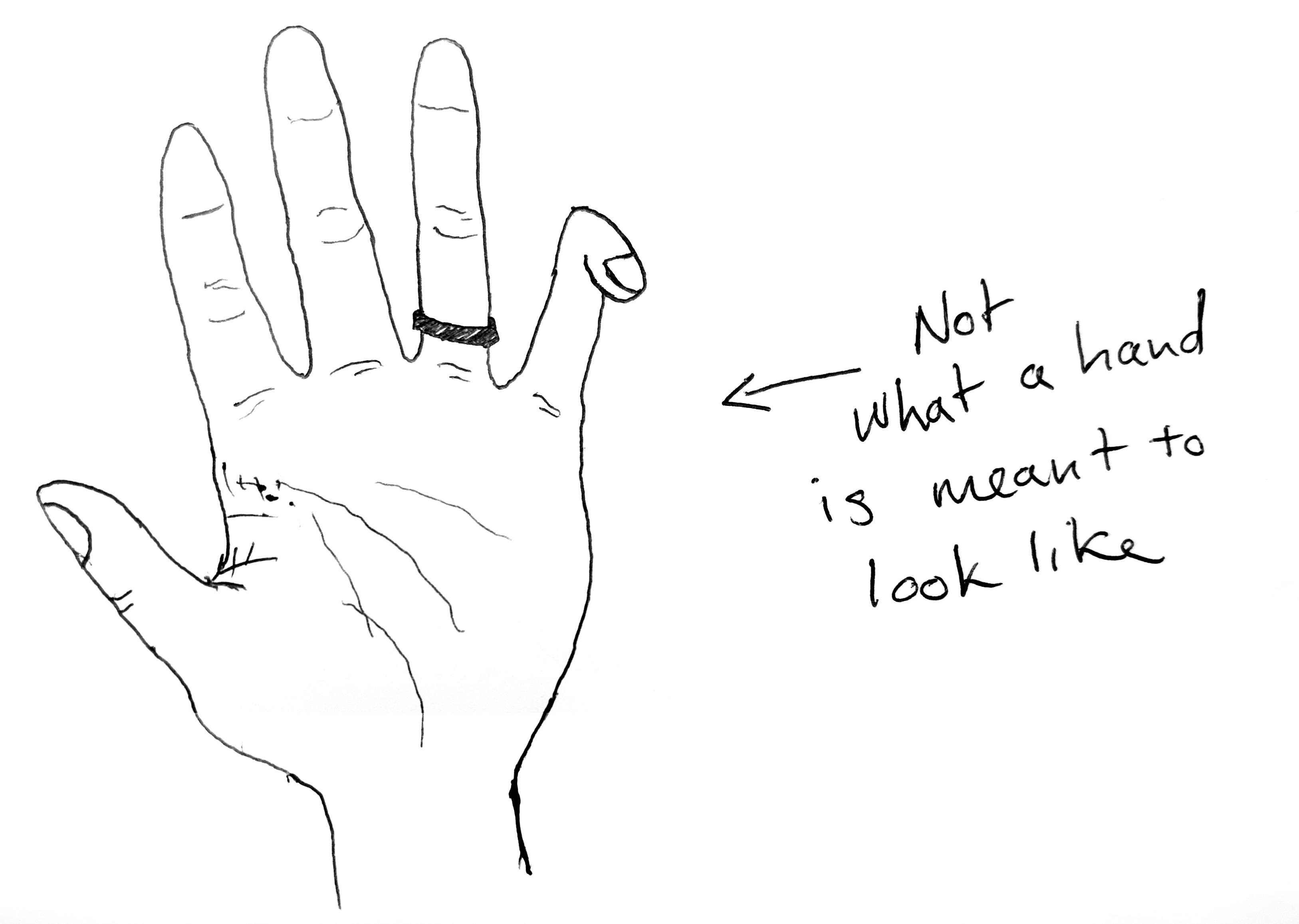
About a month ago, I looked down at my left hand while playing with my kids and noticed something a bit off. Well, more than a bit off, to be frank. The tip of my left pinkie finger was dangling off its joint all akimbo, like a snapped tree branch.
It was disconcerting.
Even more so when I went to straighten it, and discovered that was no longer an option. The “move” toggle wasn’t working, and when I forced it straight with my other hand, it just flopped back. Even worse, the position it happened to have landed in wasn’t conducive to, well, most normal hand things, like holding stuff or waving hello or petting dogs or, most importantly for me, playing piano.
Where I used to have a proud and prodigious pinkie, I now had a useless little fleshy nub jutting out at a strange angle. C’est la vie.
So I took my disabled digit over to the hospital, where the doctor told me it was probably a snapped or stretched tendon, and that, even though there wasn’t much they could do about it, it wasn’t that big a deal since people don’t use their pinkies much, “unless you happen to be a pianist or something.” Cue the slide whistle.
A moment of appreciation for the left hand pinkie is called for here. There’s a chance I’ve been under-appreciating this little workhorse for too long. The pinkie is the hobbit of the hand, a little unnoticed character that’s capable of big things. It adds width to your reach. It adds balance to the hand’s silhouette. It’s the anchor of the grip. It’s got its own special swearing ritual. And when raised while holding a cup of tea, it signifies a high level of sophistication.
For a pianist, the pinkie punches way above its weight. It’s the bass note, the root, the foundation of the harmony. It kicks off the arpeggios in Clair de Lune and drives the chugga-chuggas in stride piano. It’s really hard to play a four-note chord without it. In fact, everything is suddenly much more difficult. The Hanon finger strengthening exercises I’ve been doing since I was 12 are like trying to solve a Sudoku as I play with various alternative finger configurations.
There’s also just the fact that when you’ve learned to play stuff with five fingers, it’s really awkward to suddenly play it with four. My muscle memory has been hacked and is glitching out. Systems are down, manual override engaged!
Despite all this, I’m pleasantly surprised by how much I can play without it. It’s the ring finger’s time to shine. When a substitute comes off the bench for a superstar in a big game, it can go a few different ways, but I feel that my ring finger is stepping up. It’s auditioning for the role of bass note player, and doing an admirable job of it, even if it’s not a natural fit, like Steve Buscemi trying to play a high school student. Admittedly, I’m struggling with Chopin, but I’m fine with most of my not-too-technical songs and can share the voicings with my right hand for most jazz numbers and Christmas tunes. And of course, improvising is a game of using what you have at hand anyway (excuse the pun).
I actually played a show last night. I have more tonight and in the following days (if you’re in New York, Vermont, Rhode Island, or Montréal, come out!). It’s going well so far. I just need to be a little more deliberate in my movements, a little more pre-planned and thoughtful with what I play. I do have one song with a lot of arpeggios, and my ring finger isn’t quite as practiced in its dance moves yet, so finding the low note smoothly and at speed can be a struggle. Everyone else needs to step up, especially Right Hand, who really needs to operate without any of my attention while my focus is entirely on assisting Ring Finger in its movements.
Writing all this is making me realize what a delicate dance a skill-based instrument is. It’s pretty cool this thing we’ve learned to do, we who emerged from a bunch of cells in a primordial soup to swim the seas and crawl up on land and then find homes in the trees and eventually build houses with pianos in them.
So what’s the lesson here? I’ve struggled with this essay in some ways because the biggest takeaways all seem a little cliché for my taste. Clouds and their silver linings, rolling with punches, rough seas make skilled sailers, etc. My wife got a poster recently that says, “When life gives you a lemon… you must EAT THE LEMON.” I’m eating the lemon, and it’s fine, a little sour but flavorful. Will prevent scurvy.
There are certainly a few obvious truths here:
Sometimes things don’t go your way, and the best thing you can do is adapt.
When you have to change up the way you normally do things, you often discover new, interesting ways to do them that never would have occurred to you before.
Pinkies are great, and you should appreciate yours more than you do.
We know this from cat posters already (well, maybe not the pinkie thing, but the other two), but if you want another example, I’d point to the jazz guitarist Django Reinhardt. Django was a brilliant guitarist and banjoist as a kid, before getting severely burned in a caravan fire at the age of 18. He recovered but he lost the use of two fingers, the pinkie and ring finger. Because of this, he had to teach himself a whole new way to play guitar, using lots of tensions in his chords instead of barre chords and lots of chromatic notes in his runs since they were more conducive to only having two fingers on the fretboard. These idiosyncrasies are what allowed him to develop such a new, distinctive style of music, one with a profound popularity and influence on the world.
One of the reasons I didn’t notice when I initially hurt my pinkie is because of an accident I had when I was 12. While playing with my brother, I’d accidentally put my hand through a plate glass door, severing the main artery, the tendons, and the ulnar nerve. Because of that, I can’t make certain shapes with my left hand, like Spock’s salute, and I still don’t have much feeling in the pinkie I’ve now injured, so I didn’t feel the injury happen.
But at the time, I remember most people expected that would be the end of my piano playing. Instead, my piano teacher, an old Hungarian lady who I didn’t always love but who had continued her piano training during World War II by practicing an imaginary piano on her knees, took it as a personal challenge. She initially wanted to focus entirely on my right hand and make me so technically proficient with my right hand to make up for any deficiencies with the left. Ravel has a concerto for a one-handed pianist after all.
The interesting thing is that didn’t really work. I’m not very technically proficient, whether because my motor skills just aren’t naturally suited to it or because I didn’t work hard enough or both. So we pivoted. We slowed things down and focused on my left hand instead. We decided, even if I wouldn’t be able to play everything, the things I did play, I would play full of emotion and meaning and joy and love.
And that is what made me a pianist. That’s still what I try to do today, and it’s why I still play piano, every day, pinkie or no pinkie.
Hopefully I get my pinkie back in a few months, but the doctor’s said it probably won’t be quite the same. I’m hopeful, but also whatever happens, these are the things we build our lives on.
To borrow from a cliché, when a door somewhere closes, you can chop down that door with an ax and use its timber for a fire to keep you and your family warm. F#$%^ that door. Turn it into firewood.
Yours, in appreciation of the little forgotten things we build our lives on,
Ian
PS. Special shout out to Mads, Mika, and Marty for chiming in on the conclusion to this essay last night at my show!
—
Ian Temple
founder of Soundfly
ian@soundfly.com
Holiday Sale continues!
I’m keeping our Black Friday sale running all month long, so if you want a year-long Soundfly subscription to check out our various production, theory, songwriting, piano, and business courses, sign up anytime in December. The code is HOLIDAYS.
Five Interesting Things
Sound waves are strange beasts. I love this illustration from Dom Aversano showing how if you slow down or speed up certain polyrhythms, you actually just get harmonies. A strange and beautiful musical truth: Harmony is not what you think it is.
I’ll probably write something inspired by this at some point, but I’ve been really enjoying Fela Kuti: Fear No Man, a new podcast by Radiolab’s Jad Abumrad. As always with the Radiolab people, they treat the sound and music really beautifully throughout, and it goes deeper into certain parts of Fela’s story I didn’t know about, including an interview with his “Queens.”
Some of you already know that I’m a moderator of Ólafur Arnalds’ OPIA Community. Well, we just put together a beautiful playlist from community members’ releases this year, and I think it’s highly worth a listen. Lots of neoclassical, piano, electronic, ambient, etc. Put it on!
I actually didn’t realize that the increase in musician biopics in recent years is connected to the fact that investment firms have bought out artists’ back catalogues and want to drive attention to those catalogues. I’m pretty sympathetic to the argument that good music from the past is overshadowing the potential of new music to become classics, so I found this article on how music copyright is too long by Chris Dalla Riva pretty compelling.
Have you purchased one of my homemade coloring books yet?? Well, it’s more of a coloring book-meets-liner notes-meets-poem created to go along with my latest EP. Bandcamp Friday is the perfect time to buy!
Hi Ian,
I know I've emailed you in the past but I'll just try a comment this time.
This article was definitely a bit more personal for me since I actually only have one hand and no thumb yet I play the drums and guitar. I even just had to take a piano class in college. Anyway, it was interesting hearing about your experience adapting and seeing that video of Django. Since I never had proper limbs to begin with, I've learned that it might as well take a whole lifetime adapting and figuring out new ways to play instruments that will hopefully lead to a unique sound. I always find that to be the trickiest part because, on one hand, I want to be able to play what all my musical heroes play and be able to sound as good as good as any other musician, however on the other hand (obviously not literally), that will never fully happen so I might as well use the tools given to me to sound like no one else!
-Marcus K.
I use my pinky for piano and guitar tricks. I've had finger infections that meant not using my middle finger or pointer finger and having to hold my pick in an entirely different way. Weird, but I did it for weeks. I also sliced my pinky and it would not clot last Thanksgiving while cutting Brussels sprouts, but insisted on practicing piano and made it bleed more so had to go to urgent care. Yep. Also, many a sprained ankle, bicep tear, etc as a fitness instructor and dancer. You learn the healing process: injury, diagnosis, ice, rest, rehab, recovery and try to prevent from reoccurring.